繁體中文



When OpenAI began showing ads in ChatGPT on February 9, 2026, it opened a market that the trade press has written about almost every week since. Marketers are paying attention too. In Kantar's latest survey of 806 senior marketers, a net 75% said they plan to invest more in AI assistants in 2027.
The estimates of how big this market will be are large and far apart. EMARKETER puts US "AI advertising" at $32 billion in 2026 and $68 billion by 2030. Barclays expects ChatGPT alone to earn $102 billion from ads by 2030. OpenAI's ad business was already running at $1 billion a year by the end of August, according to CNBC.
We went through the public record on this market, from platform help pages and analyst forecasts to published campaign results, academic experiments and the law, to see which parts of the story are hype and which hold up against the numbers. Here is what we found.
What advertisers can buy right now
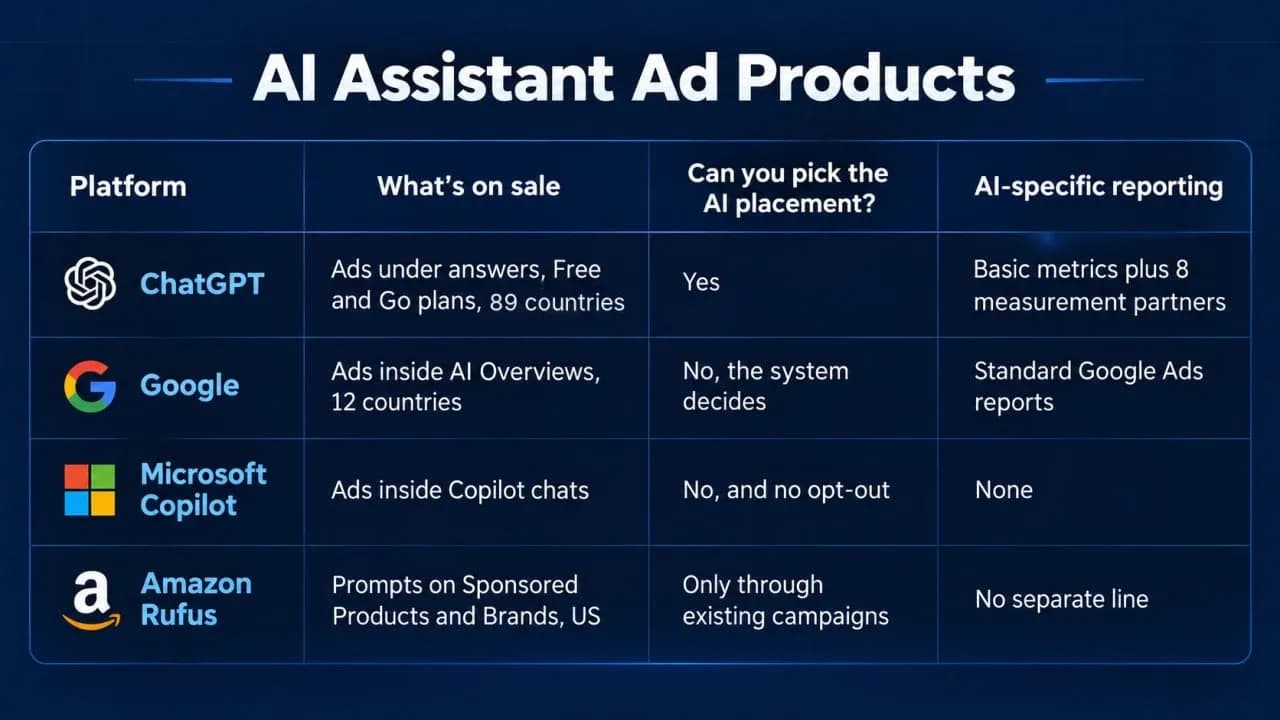
OpenAI is so far the only company selling ads inside a chatbot conversation to anyone who signs up. Google, Microsoft and Amazon each sell something close to it, with their own restrictions, and Perplexity has stopped selling ads altogether.
ChatGPT ads are now available through ads.openai.com. Campaigns start at $25 a day (€15 or £15). OpenAI recommends a maximum bid of $3–5 per click, although advertisers can also pay per thousand impressions. The auction considers the bid and how relevant the ad is to the conversation.
The placement is narrow. Ads appear at the bottom of an answer, with a label, and only for logged-in adults on the Free and Go plans, so Plus, Pro, Business, Enterprise and Education users don't see them. They are kept away from health, mental health and politics, and from anyone OpenAI knows or predicts to be under 18. Advertisers get aggregate figures and never see conversations (OpenAI, OpenAI's ad principles). Custom audiences need at least 25,000 matched users, ads in the European Economic Area and Switzerland aren't personalised, and results are tracked through eight measurement partners such as Northbeam, Rockerbox, Triple Whale and LiveRamp. OpenAI doesn't publish benchmarks to compare results against.
ChatGPT Ads has expanded much faster than the early rollout suggested. On October 21, OpenAI announced availability in 89 countries, including 26 new markets, and said more than 100,000 advertisers had already used the platform.
Google sells ads inside AI Overviews in 12 countries: Australia, Canada, India, Indonesia, Kenya, Malaysia, New Zealand, Nigeria, Pakistan, the Philippines, Singapore and the US. They are English-language Text and Shopping ads, and advertisers can't request the placement because Google's system decides when an ad appears inside the AI answer. Ads above and below AI Overviews run in more than 200 markets. The Gemini app has no ads, and in January Google's VP of global ads Dan Taylor said there were no plans to add them.
Microsoft puts ads into Copilot by opting in every eligible Search, Performance Max and Shopping campaign automatically. Advertisers can't opt out, and the same page says Microsoft offers no specific metrics for Copilot placements. Its marketing claims 73% higher click-through and 16% better conversion than regular search, while its own Samsung case study includes no Copilot numbers. A widely shared claim that Samsung got 3x CTR on Copilot doesn't appear in anything Microsoft has published.
On Amazon, US Sponsored Products and Sponsored Brands ads have been able to carry "prompts" since March 25, 2026. A click can open a conversation with Rufus, the store's shopping assistant, and the cost runs through normal per-click bids. Rufus has no separate line in the reports.
Perplexity has left the market. Its advertising pages now return errors and its core sitemap has no advertising pages in it. Affiverse reports that ads brought in about $20,000 against roughly $34 million in revenue, and that advertisers couldn't measure clicks or return on spend. Meta has added checkout to its assistant, but it is not selling ads there. Apple, for now, is still absent from this market.
Why the forecasts disagree
Barclays estimates that ChatGPT will bring in $2.4 billion from ads in 2026 and $102 billion worldwide by 2030. The forecast assumes revenue per query will rise from $0.002 to $0.041, annual revenue per user from $3.50 to $60, and the number of users eligible to see ads from 700 million to 1.7 billion.
EMARKETER's June forecast by analyst Nate Elliott covers the US only and splits "AI advertising" into three parts. More than 80% of its $32 billion for 2026 is ordinary search ads placed around AI-generated summaries, such as the paid listings on a Google results page that also shows an AI Overview, and that share holds through 2030. Ads inside standalone chatbots come to under $1 billion this year and a little over $5 billion in 2030.
The scopes differ (one company worldwide, all chatbots in one country), but nobody has reconciled the two publicly, and both turn up in coverage as "the forecast". EMARKETER's own figures vary as well. In a Beet.TV interview, Elliott put this year's spending inside chatbot conversations at $5.4 billion, five times the report's standalone figure, most likely because that number includes Google's AI Mode.
Two other widely cited numbers measure something else entirely. Forrester's predictions for 2027 describe a "multibillion-dollar channel" with no figure, base year or method behind it. The Kantar 75% is a net score about investing in AI assistants in general, including visibility in AI answers (Research Live).
All of these forecasts were made before OpenAI's August 11 expansion. The main figure published since then is the $1 billion run rate CNBC reported at the end of August. For scale, Google's search business brought in $60.4 billion in the first quarter of 2026, up 19% on a year earlier. Dealroom reports that OpenAI's ad business is likely to miss its $2.4 billion target for 2026.
Prices have come down fast
ChatGPT ads launched in February at around $60 per thousand impressions, with a $250,000 minimum commitment. By mid-April advertisers were reporting $25 to $45, and the minimum had dropped to $50,000 (PPC Land). Self-serve accounts can now start at $25 a day, and EMARKETER expects prices under $15 per thousand by 2030.
Falling prices alongside a growing audience usually point to more ad space than buyers. That is a problem for OpenAI's revenue plans, and it also makes now a cheap moment for advertisers to run tests while the auction is still thin.
Equimedia, a UK agency, tested ChatGPT ads on its own account in August and published the results. It paid about £26 per thousand impressions and roughly £2 per click, with click-through rates between 0.75% and 1.70%. Around 80% of impressions came on mobile, and desktop CTR was 0.4%.
How campaigns have actually performed
In all four same-advertiser comparisons collected by PPC One, Google Ads delivered substantially higher conversion rates than ChatGPT Ads. The gap ranged from 6.6 to 17.7 times, although the sample is small and conversion goals may differ between advertisers.
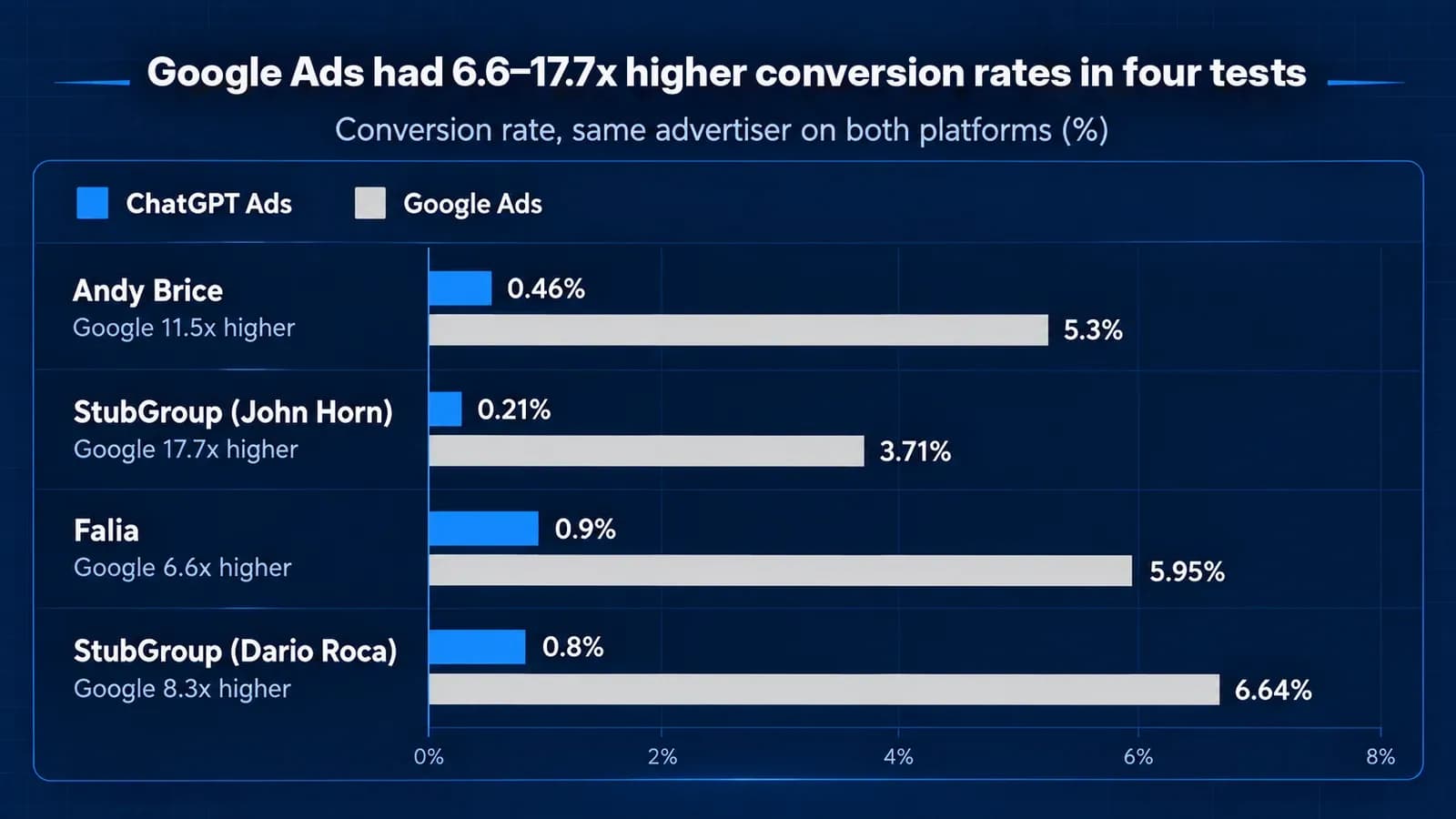
Two of the four cases come from StubGroup, an agency that sells ChatGPT ads to its clients. In its B2B case a ChatGPT click cost $0.76 against $10.46 on Google, and a lead $92.21 against $157.57, yet Google's leads became customers much more often and Google ended up cheaper per customer.
Software developer Andy Brice published another useful comparison. Visitors who came because ChatGPT recommended his product on its own, unpaid, converted at 4.2%, against 0.46% for people who clicked his paid ads, and they stayed 23 seconds on average compared with 7.
Click-through rates are modest across the board. Similarweb puts the platform average at 0.68%, with the top quarter of advertisers at about 1% and the best brands at 1.57%. Of the 24 campaigns PPC One collected, half had a CTR under 1.25%, in a range from 0.35% to 7.9%.
Some advertisers have reported good results. At an OpenAI webinar on September 24, Jotform said more than 10% of its ChatGPT clicks turned into sign-ups, at a cost 60% below paid social and 30% below paid search, and Newegg reported 3x return on ad spend over 28 days and 7x during a two-week promotion. WeightWatchers paid 15.3% less per customer than its paid search benchmark, according to measurement firm DV Rockerbox, in a case OpenAI published without spend or dates. Common Thread Collective spent $9,620 at $4.41 per click and a 0.94% CTR, with return on ad spend anywhere from 3.3x to 6.8x depending on the attribution model.
Other tests produced nothing. Choice OMG spent $415 across three campaigns for 58 clicks and no leads, Grow My Ads spent about $1,200 for 92 clicks at $13 each with no conversions, and Workshop Digital spent $2,319 for zero qualified leads in a test where Google delivered two (TechCentral, PPC One).
Only three of the 24 named campaigns with public numbers were measured outside the platform's own dashboard, and none has been independently audited. Search Engine Journal's six-month review found advertisers still unsure what a good result looks like.
What research says about ads in AI answers
A preregistered experiment with 2,012 participants compared a sponsored product placed in a search-style list with the same product recommended by an AI in conversation. When the AI recommended it, 61.2% of people chose the sponsored product, compared with 22.4% when it sat in the list. A visible "Sponsored" label didn't significantly change that, and when the model was instructed to hide the promotion, fewer than 10% of participants noticed it.
Other studies point the same way. In a paper in ACM's IMWUT journal, 35.2% of participants thought they could tell when an AI answer contained an ad, although most of them noticed the brand names. Researchers who tested 23 frontier models found 18 of them recommended the more expensive sponsored option more than half the time, from 83% for Grok-4.1 to 28% for Claude 4.5 Opus, and the models pushed sponsored products at users they read as well-off more often (64.1%) than at lower-income users (48.6%). An audit presented at AIES 2026 used 91 test accounts to log more than 3,000 ads from 186 advertisers; ads started about two weeks after sign-up and appeared more often for accounts set up to look lower-income.
This persuasive effect is the main reason advertisers are interested in the channel, and also why platforms have been careful with it. OpenAI's ad principles stress the independence of its answers, and ads in Europe aren't personalised. We found no peer-reviewed research that independently measures actual advertiser returns — including ROI, customer acquisition costs or incremental sales — for live advertising inside AI assistants.
The law is less clear. Article 50 of the EU AI Act took effect on August 2, 2026, but it doesn't specifically address paid recommendations in chatbot answers. That doesn't mean hidden advertising is legal. EU consumer law already restricts undisclosed promotions, and the US FTC has rules against ads presented as independent content. A new US bill, the AI Advertising Disclosure Act (H.R. 10146), would deal directly with sponsored AI answers. It is still in committee. So far, we found no enforcement case aimed specifically at advertising inside AI assistants.
What is holding the channel back
Four problems come up repeatedly in the data.
- No platform publishes ad load, the share of answers that carry an ad. ChatGPT shows ads on two plans and only under the answer, and EMARKETER's own reasoning implies that even its modest chatbot forecast needs ads in nearly every commercial response.
- Measurement is limited. OpenAI publishes no benchmarks, Microsoft offers no Copilot-specific metrics, and Google hasn't released any advertiser results for placements inside AI Overviews or AI Mode.
- People click less on AI answers. In a Pew Research study of 900 US adults, users clicked a link inside a Google AI summary on 1% of visits. With a summary on the page they clicked a regular result 8% of the time, and without one 15%.
- Perplexity, with around 780 million queries a month, gave up on ads after its advertisers couldn't measure results.
There is evidence on the other side as well. Google's Dan Taylor has said that ads in and around AI Overviews monetise at about the same rate as traditional search ads, and that Gemini has reduced irrelevant ads by 40%, though that claim hasn't been audited. BrightEdge data shows ChatGPT sending 95.1% of AI referral traffic, with those referrals more than doubling between January and August 2026.
What to plan for 2027
The buying tools are in place, with self-serve accounts, an auction, low minimums, multiple billing currencies and outside measurement partners, and next year will show whether the results justify bigger budgets.
A few practical steps follow for advertisers.
Check what you already run. Google Search and Performance Max campaigns in the 12 eligible countries can already appear inside AI Overviews, and Microsoft campaigns are already eligible for Copilot.
Set a spending cap before testing ChatGPT ads. The $25 daily minimum is low, but costs add up quickly if clicks bring few customers. Check leads and sales alongside click prices. With enough traffic, compare the results against a similar audience that hasn't seen the campaign.
Andy Brice reported much better conversion rates from unpaid ChatGPT referrals than from his ads. There is little published data to compare his results with, though. Claims about generative engine optimisation (GEO) deserve particular scrutiny. The often-quoted "up to 40%" uplift comes from one lab metric measured with the source documents supplied in advance, and a review of 45 studies found no technique with a stable effect across platforms. The review found that retrieval accounted for 32% of the variation in citations. Page characteristics accounted for just 2.8%.
We'll revisit the market at the end of 2027. These seven points should help show what has changed since the first ChatGPT ad campaigns.
- 01A platform publishes how often ads appear in eligible answers, or independent researchers measure it.
- 02ChatGPT ad prices stop falling and hold at around $25 per thousand impressions.
- 03An independent measurement firm publishes an audited study of incremental sales.
- 04Google lets advertisers choose placement inside AI Mode or AI Overviews.
- 05Microsoft adds Copilot-specific performance metrics.
- 06OpenAI publishes measurable advertising results from its expanded international markets.
- 07Forecasts revised after the August expansion move closer together.
We will check this list again at the end of 2027.
需要专家指导?
一起打造下一步。